
Stop Nagging, Start Teaching

Fix Bow Holds Without the Burnout
We have all been there. You started teaching because you are passionate about the violin, but six weeks into a new term with a group of energetic beginners, you realise you have spent 90% of your time stuck on repeat. You do all the voices: kind, gentle, funny: trying to curb your inner frustration. You know you need to cure bad habits before they even start, but it can be an immense drain on your energy.
“Keep that thumb curvy.” “Watch your pinky.” “Don’t let the bow slide.”
By the time you actually get to play a note, half the class is discussing their plans for the weekend and the other half is mooching around, bored to tears. You have officially become a “Chief Nagger”: that version of yourself where your voice simply becomes background noise to a distracted child.
The “Children’s Performer” Myth
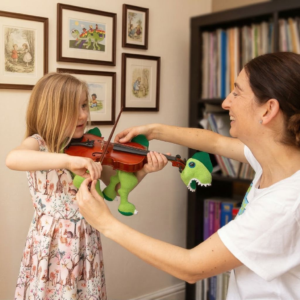 I have spoken to many wonderful, traditional teachers who worry that making lessons “fun” means they have to act like some kind of children’s performer, prancing around like a circus clown whilst simultaneously teaching a G major scale. They find the idea exhausting and, frankly, beneath the dignity of the instrument.
I completely agree.
The truth is, you don’t need to be an oscar worthy entertainer to be a great violin teacher. In fact, trying to “perform” for huge chunks of your working day is the quickest route to teacher burnout. The secret is not in you becoming a circus act; it is in having a toolkit that does the heavy lifting for you.
Shifting from “Correction” to “Challenge”
 The “Setup Phase”, those critical weeks spent on bow holds and basic posture, is the most vital time for a technical foundation. However, we are often trying to teach adult concepts (mechanics and ergonomics) to brains wired for play.
When we constantly “correct,” we become white noise. But when we use a narrative anchor, we become part of their world. This is where Pool Rescue™ comes in.
It is a pedagogical tool designed to teach the subtle complexities of flexibility, balance, and softness without the constant verbal reminders.
Introducing: Pool Rescue™
Instead of repeating technical instructions, imagine inviting your students into a story where every finger has a vital role in a high-stakes rescue mission.
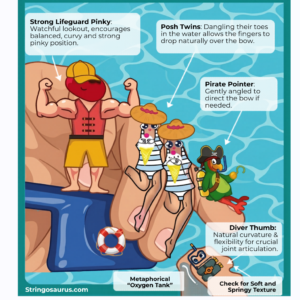
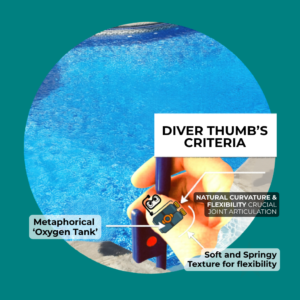
- Diver Thumb™: He must always remember to stay flexibly curved. The curve is his oxygen tank, allowing him to survive underwater. If he forgets to check his oxygen and goes straight or tense, it is a disaster!
- The Tactile Check: As the teacher, you can perform a “safety check” by pressing gently on the bend of the thumb: the oxygen tank. The bend should feel soft and springy; when you let go, the thumb should automatically re-curve. This provides the student with a physical sensation of success.
- The Posh Lady Twins™: The two middle fingers flopped over the bow are far too elegant to swim. They simply dip their toes in the water because it is much too cold for them.
- Lifeguard Pinky™: This character usually makes children roar with laughter. He is strong and muscular, but will he be ready for his heroic moment, or will he have fallen asleep and fallen off his lookout?
By asking a child, “Is Diver Thumb™ breathing?”, you are not nagging. You are engaging their imagination to achieve a precise technical result: a relaxed, curved thumb.
Why “Pool Rescue™” works (The Science Bit)
For the traditionalists among us, this is not just a silly story. It is a precise technical framework. By using these characters, you are encouraging a neutral, relaxed hand alignment. You are preventing the “locked” joints that block bow agility and make a fluid legato impossible.
You can tell the story ad-lib, use the PDF book, or let the interactive video do the work for you. You get to remain the expert observer, checking the balance and the soft joints, while the narrative keeps the child’s imagination engaged.
How to access Pool Rescue™
 I built the Stringosaurus Hub to act as your “silent assistant” as a way to take those repetitive, “boring” movements and wrap them in stories that children actually care about.
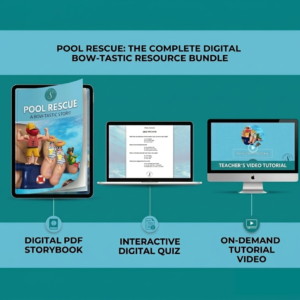
You can currently access the full Pool Rescue™ resource pack as part of my free trial. This includes:
- Pool Rescue™ Storybook: Provided in PDF and PPTX formats for easy classroom display.
- Interactive Video: An alternate version using “Competitive Pointer” or “Pirate Pointer” to suit your teaching style.
- Teacher’s Video Tutorial: A very quick guide on how to implement these characters effectively.
- Printable Student Quiz: To reinforce the learning and ensure they never forget their bow-hold again.
Retiring the “Chief Nagger”
When the setup is fun, students feel successful from the very first day. When they feel successful, they stay. And when they stay, you get to do what you actually love: teaching music.
The Hub provides the visuals and the creative framework so you can focus on the technique, rather than reinventing the wheel every Monday morning.
Laura Carr is the creator of Stringosaurus, where she helps teachers turn ‘herding cats’ into making music. You can find more of her play-based resources and the original version of this guide at
Stringosaurus.com.