
Remembering Lyndal Edmiston
11 February 1933 – 26 November 2025
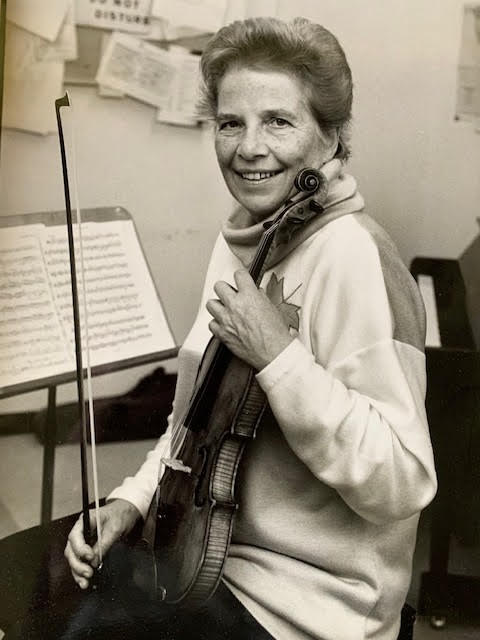
With the passing of Lyndal Edmiston, Australia farewells one of its most quietly influential musicians, a devoted teacher and a compassionate advocate whose life shaped generations of young musicians.
Born in 1933, Lyndal grew up in St Lucia, Brisbane, where she attended Ironside State School. She often spoke of walking through the bush to reach school during and after the war, long before the suburb was developed. Her father, Ernest Edmiston, was a talented violinist and, at the age of 12 went on a four year scholarship to London’s Royal Academy for further study. On returning to Australia he diverted to a scientific career, eventually becoming professor of applied chemistry at the University of Queensland, but remaining still very much involved in music, both as violinist and as pianist. He contributed significantly to Lyndal’s musical upbringing. His wife May was an amateur singer.
On completion of school at Brisbane Girls’ Grammar, Lyndal completed an Arts degree at Queensland University. Wishing to pursue a career as violinist, she enrolled at the NSW State Conservatorium of Music, Sydney, studying with Phyllis McDonald. It was there in 1952 that she met Leon, who fulfilled a role as accompanist and, much later, became her husband.
In 1955, Lyndal was awarded the Pedley Woodley McMenamin Scholarship, enabling her to study with Frederick Grinke at the Royal Academy of Music, London. There, in 1957 she won the John & Arthur Beare Bow Prize, receiving a gold-mounted W.A. Pfretzschner bow. She then studied in Augsburg, Germany with Rudolf Koeckert.
In 1960 she returned to Australia, fortuitously at about the same time that eminent Czech strings pedagogue Jan Sedivka came from London to join the Conservatorium staff in Brisbane. Jan, his pianist wife Beryl and cellist Sela Trau had previously comprised a successful performing group, the London Piano Trio. Lyndal was fascinated by Jan’s no-nonsense approach to teaching and studied with him from time to time. Subsequently, Lyndal went to Hobart and became a member of the Tasmanian Symphony Orchestra in the mid 60s. She also then acquired her first dog, a lovely German Shepherd called Dascha.
Lyndal and Leon married in Sydney in 1970 and Lyndal played occasionally in the Sydney Symphony Orchestra. Meanwhile Jan Sedivka had become Director of the Tasmanian Conservatorium, string student numbers were burgeoning, and, at his suggestion, Lyndal joined his staff.
Lyndal and Leon lived initially in an old house on Mount Nelson but acquired some land in Margate and in 1980 built an octagonally themed house of Tasmanian timbers, chiefly Celery Top pine. The design included provision for a large music room, which served well both for private teaching and for the presentation of concerts to audiences of up to 50 people.
Outside music, Lyndal served the community in many ways. Lifeline was starting up in Hobart in 1973 and Lyndal was attracted to the idea of being a volunteer telephone counsellor. She undertook the preparatory training course and then served as a telephone counsellor for seven years. Whether serving for Lifeline or fundraising for multipole sclerosis, these were just examples of how Lyndal threw herself wholeheartedly into causes she believed in.
The 70s and 80s proved to be frenetic but joyous times, thronged with musical activities, student get-togethers, parties, dogs, gardening and bees. She was very aware of the developing technologies, was keen to acquire one of the first Apple computers and then updated annually as each new model appeared. It was Lyndal who introduced the first ride-on mower for use in the Margate property. Gadgets and new ways of doing things always caught her attention.
Lyndal built a career defined by service rather than self-promotion. She became a respected Lecturer in Violin and Chamber Music at the University of Tasmania, master-minding the complex annual string summer schools. She became Musical Director of the Tasmanian Youth Orchestra and was a long-serving AMEB Examiner. Her editorial leadership of the AMEB Violin Series 6 in 1994 revitalised the syllabus and broadened the musical landscape for young violinists across the country.
Regarded as an exponent of the mysterious Sedivka teaching model (there was no model!), Lyndal was highly sought after by the strings community. She engaged in many workshops and promoted the ideals of the Australian Strings Association. Lyndal was also very much involved in the development of AUSTA’s Stringendo magazine. In 1989 she co-authored with Leon a booklet “Beginning the Journey”, which detailed the story of the Tasmanian Conservatorium’s first 25 years.
Yet Lyndal’s greatest legacy lives in the people she taught. She made her students feel worthy, trusted, respected, listened to, valued, and safe. She believed deeply in the moral responsibility of teaching – that every lesson must serve the wellbeing and future of the child. Lyndal guided her students in how to problem-solve thoughtfully during practice, nurturing independence and curiosity. She illuminated the kinaesthetic side of violin playing – the feel of movement, posture and muscle memory, empowering her students to understand their own bodies as instruments.
Sadly, Lyndal’s health began to deteriorate in the early 2000’s and, to the regret of many, she began to withdraw from teaching and entered a long period of reclusiveness.
Lyndal leaves behind a legacy of music, mentorship, and humanity. She will be remembered for her warmth, integrity, and the countless lives she shaped with her enquiring mind and generosity of spirit.